DEFINITION
The High-Trust Ascent™
The five stages every prospect climbs before they buy.
By Stuart Bell
Take the Assessment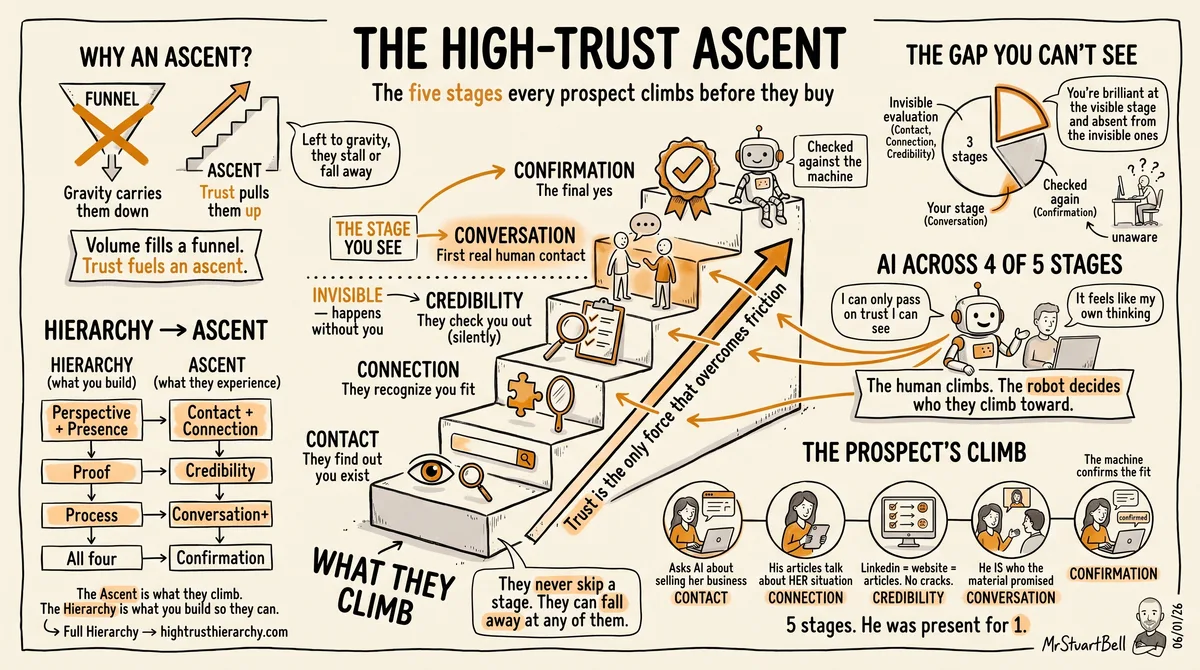
The High-Trust Ascent™ is the five stages a prospect climbs before they commit to a High-Trust Business™: Contact, Connection, Credibility, Conversation, Confirmation. They never skip a stage, and they can fall away at any of them.
If you run a High-Trust Business™, the kind where prospects need to feel a connection with a real person before they buy, you've spent your career thinking about the conversation. The call, the consultation, the first meeting. That's the part you can see. It's the part you're good at. It's the part that, for years, did most of the work.
Here's the problem. The conversation is no longer the whole game. It's the fourth of five stages, and where in the past prospects engaged with you for all of them, now they take the earlier steps without you.
That gap is where most high-trust businesses lose clients they should have won, and never find out why.
This article is about the full ascent. What the prospect actually goes through, stage by stage, from the moment they first become aware they have a problem to the moment they say yes. The stages they move through silently, the stage you live in, and the stage that happens after the handshake.
The robot elephant in the room
A word about AI before we go further.
If you've read the definition of a High-Trust Business™ or the High-Trust Hierarchy™, you'll have noticed AI is there, but it's secondary. That's deliberate. What a High-Trust Business is, and what its owner needs to build, are both true whether or not a single robot exists. AI raises the stakes, but it doesn't change the substance. So in those pieces, the concept comes first and AI comes second.
The Ascent is different, because the way clients move through it has changed more than the journey itself has.
The stages are the same journey they have always made: find out you exist, recognize you fit, check you're for real, talk to you, decide. That hasn't changed and it isn't going to. What's changed is who's walking the prospect through it.
It used to be the prospect, more or less alone, with a few familiar intermediaries. Google results. A directory. A referral from someone they knew. The intermediaries were known quantities, and you understood how to show up in them. Most of the journey, the prospect managed themselves, and most of the trust-building landed in the one place you could influence it directly: the conversation.
Now there's a new intermediary, and it isn't a known quantity, and it's doing far more of the work. Your prospect has handed a large part of this journey to their favorite AI assistant, willingly and enthusiastically. Not because they were forced to and not because they're lazy, but because it feels like better thinking. They experience the robot's research as their own. So across the first three stages, the robot is the one finding the options, recognizing the fit, and running the credibility check. And at the final stage, the prospect comes back to it to confirm the decision, treating it as the trusted advisor whose read they believe most.
That's why you can't read the Ascent without reading the robot into it. And here's the part that carries through everything below: the robot isn't trying to replace the human journey. It's trying to help its user make the climb they were always going to make, by surfacing the right person and confirming the sound decision. But it can only do that with what it can see. If the pieces of your business aren't visible to it, it doesn't decide you're a bad choice. It decides you're not a choice, and it helps its user climb toward someone else.
So read what follows on two levels at once. Underneath, it's the same human ascent it's always been, driven by the same human need for trust. On top, sitting between you and the prospect across four of the five stages, is an AI intermediary that can only pass on the trust it can actually see. The human still makes the climb. The robot increasingly decides who they climb toward.
The human still makes the climb. The robot increasingly decides who they climb toward.
Why an ascent not a funnel
Most marketing is built on the funnel. Get leads in the top, move them through the stages, customers come out the bottom.
The whole model rests on one assumption: momentum runs downhill, toward the sale. Put the pieces in place, get enough leads into the top, and the momentum of the funnel carries them down to the close. The work is filling the top. Gravity does the rest.
That assumption holds when the purchase is small, reversible, or low-consequence. A cheap product, an easy decision, a buyer who can afford to be wrong. But it's the wrong model for what you do. Not because the stages are different. Because the momentum is reversed.
A High-Trust purchase doesn't run downhill. It climbs uphill. The prospect isn't carried toward the sale by the momentum of your process. They have to climb every stage, against doubt, against inertia, against the cost of being wrong about something that matters, against the simple friction of changing anything at all.
Left to gravity, a high-trust prospect doesn't drift toward you. They stall or fall away.
I first came across the inverted funnel through Flint McGlaughlin's work, and this is the piece that reframed it for me. In an ascent, you can put all the pieces in place and nothing moves at all, because there's no downhill momentum to carry anyone. The pieces don't move people. Something else has to.
That something is trust. Trust is the only force that overcomes the friction at each stage and earns the prospect's climb to the next. Enough trust at Contact, and they'll recognize the Connection. Enough at Connection, and they'll do the work of checking your Credibility. Enough there, and they'll pick up the phone. Not enough at any stage, and the friction wins and the ascent stops, right there, silently.
So the funnel and the Ascent ask different questions. The funnel asks "how do I get more in the top?" The Ascent asks "is there enough trust at each stage to overcome the friction?" Volume answers the first. It does nothing for the second.
The funnel asks "how do I get more in the top?" The Ascent asks "is there enough trust at each stage to overcome the friction?"
The asymmetry at the heart of it
The challenge now is that prospects increasingly move through Contact, Connection, and Credibility before they ever speak to you.
That's three full stages of evaluation happening while you have no idea they exist. They find you, they decide you might fit, they check you out, and they make most of their decision, all before a single word passes between you.
Only then comes Conversation. The stage you can see. The stage you've been good at for twenty years.
Then Confirmation, the final yes. Except the final yes now happens somewhere you can't see either, because the prospect takes the decision away from the room and checks it somewhere else before they commit.
So the part of the journey you've optimized your business around, the conversation, is one stage out of five. And the three stages that decide whether you even get the conversation are the three you never see happen.
This is why high-trust business owners so often feel like the best-kept secret in their market. The trust is real. It's in the room, every time, when a prospect actually meets them. It just isn't anywhere the prospect could find it before they got there. The owner is brilliant at the visible stage and absent from the invisible ones.
For most of your career, that was survivable, because the invisible stages were small. The surface a prospect could weigh you against was tiny. A handful of competitors showing up in the same searches. Maybe some SEO work. A directory listing. The referral network.
The environment was quiet, the intermediaries were few and familiar, and the barriers to getting into a conversation were low. So the first three stages went by quickly and lightly, and the prospect arrived at the conversation with most of the real evaluation still to do. You could jump almost straight to the stage you're good at, and do the trust-building there, in person, where you've always done it best.
That shortcut is gone. The environment is loud now. Every competitor publishes, the volume of content is overwhelming, and AI sits on top of all of it answering prospects' questions in extraordinary detail before they ever speak to anyone. The long tail of what a prospect can now ask, and get a specific answer to, is effectively endless. "What should a founder do with concentrated stock before a sale?" used to be a question they brought to the conversation. Now it's a question they ask their assistant, and the assistant answers it using whoever documented the best thinking on it.
It means the invisible stages aren't small anymore. They're most of the journey. And every piece of your Perspective that used to come out naturally across a conversation now has to exist somewhere the prospect and their assistant can find it first, in writing, in video, in whatever form your audience actually consumes. The thinking that lived in your head and came out when you met someone is now the entry requirement for getting to meet them at all.
The Ascent matters because those invisible stages are completely visible to your prospect. They're living every one of them. Once you can see the whole climb the way they do, you can build for the parts you've been missing, instead of pouring more effort into the one part you've already mastered.
The five C's
Each stage is a step the prospect has to clear before they reach the next. Each is a point where they can quietly fall away. And each is a chance for you to remove the friction that would have stalled the climb.
They become aware you exist and have a reason to engage.
They recognize you can help with their specific situation.
They look for confirmation signals before they reach out.
The first real human contact, where trust gets anchored.
The final yes, increasingly checked against AI before it's given.
The first three happen without you. The fourth is yours. The fifth happens partly without you again. We'll walk each one, and we'll spend the most time where you can see the least.
Contact: they find out you exist
Step one. People need to know you exist, and need a reason to engage. If you're invisible at this stage, the ascent never starts. There's nothing to climb.
For most of your career, Contact happened in ways you could roughly track. A referral. A mention at a networking event. Someone who saw you speak. A Google search that landed on your site. You couldn't see all of it, but you could see enough to know it was happening.
That's no longer where most Contact begins. Two things changed at once. The invisible side moved earlier, because AI now starts the search before the prospect consciously goes looking. And the visible side stopped running itself, because the referrals and networks you used to let happen on their own now have to be worked deliberately, or a more organized competitor takes that ground.
Start with the invisible side. Your prospect now starts with an AI assistant. They've got a problem, they open a chat window, and they describe it in their own words. Not "find me a financial planner." More like "I'm selling my business in a couple of years and I don't know how to think about what comes after." The assistant doesn't return ten blue links. It thinks the problem through with them, suggests how to frame it, and starts shortlisting approaches and the kinds of people who handle this well.
By the time your prospect is consciously "looking for" someone, their assistant has already framed the problem and named a handful of options. Contact happened. You either made the list or you didn't. And if you didn't, you'll never know you were in the running, because there was no running. There was just a conversation between your prospect and a machine, and you weren't mentioned in it.
This is the first place the asymmetry bites. You can't influence this contact opportunity in the moment. You can't read the room and adjust. You're not in the room. The only thing that gets you named at Contact is what you've already made findable before the prospect ever went looking. Your documented Perspective, sitting somewhere the AI can read it. Your Presence in the places it pulls from.
And Presence can't be left to chance anymore, on either side. For years you could let it happen to you, a profile here, a listing there, a referral when a happy client remembered to make one, whatever accumulated over time, and trust the conversation to make up the difference. That worked when the surface was small and quiet. It doesn't work now, because someone else in your category with a more orchestrated plan is actively building Presence in the exact places your shared prospects spend their attention, and they'll be the one who gets surfaced. That's true of the AI shortlist, and it's just as true of the referral that gets made at a dinner or the network you show up in. Contact isn't a passive outcome of being good at your job. The referrals and introductions you used to wait for have to be cultivated, and the channels you show up in have to be chosen. Contact is the result of deliberately showing up where your clients already are.
That means choosing your channels and going deep in them, not spreading thin across all of them. A handful of places where your prospects genuinely gather, covered properly, beats a token presence everywhere. The podcasts they actually listen to, the publications they actually read, the platforms where they actually ask their questions. Pick the few that matter for the people you serve, and be fully, consistently present there, with your real Perspective, often enough and clearly enough that both the prospect and their assistant keep encountering you. Thin and wide gives the machine nothing to hold onto. Deep and deliberate is what makes Contact possible at all.
If your perspective only exists in your head, or only comes out when you're face to face, it doesn't exist at Contact at all. The machine can't surface what you never wrote down.
If you're not findable, you're not in the climb.
Connection: they recognize you fit
They know you exist. Showing up deliberately got you that far. Connection is about what you showed up with, because now they have to recognize that you, specifically, can help with their situation, specifically.
This is the difference between "this is a financial planner" and "this is the financial planner for someone in exactly my position." Existing isn't enough. The prospect has to see themselves in what you do. They have to make the link between your work and their outcome, and decide they're the kind of person you work with.
Connection is where specificity wins and generality loses. A prospect selling a business doesn't connect with "comprehensive wealth management for all of life's stages." They connect with someone who talks about the sale, the earn-out, what to do with a sudden concentration of illiquid wealth, the strange identity gap that opens up when the thing you built is no longer yours. The more precisely you describe their actual situation, the stronger the connection.
This is also where being a generalist stops working, and not just with the AI. In the real world too, the noise has raised the friction at this stage past what a generalist can overcome. A general referral ("you should talk to my financial advisor"), a broad ad, a page of SEO content aimed at everyone, none of it carries enough specificity to move a prospect from Contact to Connection anymore. The prospect has too many options and too little reason to believe any particular one is for them. The inertia wins. They don't ascend, they stall, and you never know they were there. Specificity is what lowers the friction. The referral that lands is "you need the planner who works with founders heading into a sale," not "you should talk to my advisor." The same precision that gets you connected inside the AI is what gets you connected in the room, on the call, and in the introduction.
And the AI raises the stakes on exactly that precision. Like Contact, this stage now also runs largely through their AI. When the assistant compares the options it surfaced, it's matching the specifics of the prospect's problem against what it can find about each provider. The provider whose material speaks precisely to this prospect's situation gets connected. The provider whose material is generic gets passed over, because there's nothing specific for the match to catch on.
And here's the part that's hard to accept. The AI is doing this matching on the prospect's behalf, and the prospect experiences it as their own thinking. They don't feel like a machine shortlisted you. They feel like they looked into it and you seemed right. The Connection gets made, or doesn't, inside an evaluation the prospect believes is entirely their own.
You can't be in that evaluation to make your case. You can't say "actually, what you're describing is exactly what I specialize in." You either already said it, in writing, somewhere the AI could find it, or you didn't. The Connection is built from your documented Perspective meeting their specific need, with no human present on your side to bridge any gap.
This is the recurring lesson of the invisible stages. Anything you'd normally fix in conversation has to be built in advance, because there's no conversation yet to fix it in.
Credibility: they check you out
Now they're interested. Before they'll pick up the phone, they look for confirmation that the interest is justified. This is the silent evaluation stage, and it's where more high-trust deals are quietly lost than anywhere else.
The prospect is looking for proof. Reviews. Case studies. The content you've published. What you've written, who's written about you, who's recommended you. They're cross-checking the position that connected with them against the evidence that you can actually deliver on it. They want to see that the perspective isn't just talk.
Most of this happens without a trace. The prospect reads three of your articles, scans your case studies, checks whether your LinkedIn matches your website, notices whether the way you describe the problem stays consistent everywhere they look. They're building a picture, and they're looking for cracks. A business that gets eliminated here never knows it was being considered. There's no enquiry, no rejection, no feedback. Just silence that the owner reads as "no one's interested," when the truth is people were interested and went looking and didn't find enough to continue.
The thing they're really testing for is congruence. Does the perspective that drew them in hold up across everything else? Does the case study prove the specific claim, or just say "happy client"? Does the article go deep enough that only someone who's done this work could have written it? Does it all point the same way, or does the story fall apart the moment they scratch the surface?
Their AI assistant is running this same check, faster and more thoroughly than any human would. It scans your website, your reviews, your content, your professional listings, your social presence, and it does it in seconds, looking for exactly the congruence the prospect is looking for. If everything aligns, you clear Credibility and earn the conversation. If your Perspective says one thing and your Proof shows another, the gap gets caught instantly, and you're dropped before you knew you were up for consideration.
Credibility is brutal precisely because it's silent. You don't get to explain the gap. You don't get to say "oh, that old testimonial doesn't really represent what we do now." Whatever's there is what gets judged, and whatever's missing counts against you, and you never hear about any of it.
What clears this stage is the same thing that cleared the last two. Real, specific, congruent evidence, documented and findable, that proves the position the prospect connected with. Build that, and the silent evaluation works in your favor. Skip it, and the silence is the sound of prospects deciding against you.
Credibility is brutal precisely because it's silent. You don't get to explain the gap.
Conversation: where you've always shone
Three stages in, the prospect picks up the phone, or books the call, or walks through the door. This is the stage you know. The call, the consultation, the first real meeting. High-trust business owners have always lived here, and they've always been strong here. This isn't the stage I need to teach you.
But one thing has changed about it, and it's worth calling out.
For years, the conversation was where you plugged every gap. A prospect arrived with a half-formed idea of what you did, and you filled in the rest in real time. They had a doubt, you addressed it on the spot. They'd misunderstood your approach, you corrected it face to face. The conversation could carry an enormous amount of weight, because it was where everything finally got said properly.
Conversation can't do that job anymore, because by the time it happens, three stages of evaluation have already concluded. The prospect didn't arrive blank. They arrived with a position they've already formed about you, built from your Perspective, your Presence, your Proof. The conversation isn't where they find out what you're about. It's where they check whether the person in front of them matches the one they've been reading.
That makes the conversation a congruence test more than a pitch. If everything you've published said you're the planner who believes diversifying early is wrong for founders heading into a liquidity event, and then you sit down and hedge, or you can't explain why you believe it, or you sound like every other advisor, the prospect feels the disconnect immediately. The person doesn't match the position. And that gap does more damage than no position at all, because it breaks the trust the first three stages built.
When it's working, the opposite happens. The prospect has spent weeks, maybe months, ascending through a coherent experience of you. Then they meet you, and you are exactly who the material promised. Same perspective, same language, same depth, now with a human being attached. The trust doesn't have to be built from scratch. It gets confirmed and deepened. The prospect isn't asking "what do you do?" They're asking "how do we start?"
So the work at Conversation isn't to get better at conversations. You're already good at those. The work is to make sure the person in the room is congruent with everything that got the prospect to the room. Say in person what you say in print. Be, face to face, the version of you they already decided to trust. The conversation is still where trust gets anchored. It's just no longer where trust gets invented.
And this is where the asymmetry finally turns in your favor, because it points at an advantage you've been sitting on the whole time. Look back at the five C's. Contact, Connection, Credibility, Conversation, Confirmation. You already do every one of them well. You already have a real Perspective, you've earned it over years of doing the work. You already make the Connection, every time you sit down with the right person. You already have the Credibility, in the form of clients you've helped and problems you've solved. You're already strong in the Conversation. None of this is a new skill you have to acquire. It's a set of things you already do, that simply used to live in your head and in the room instead of in writing.
That's a much bigger advantage than it sounds, because of how congruence works. Anyone can decide to enter your category tomorrow and try to fabricate their way up the Ascent. Generate the articles, buy the reviews, manufacture a Perspective they don't actually hold. But fabrication fails the congruence check, and it fails it everywhere at once, because there's no real history underneath it to keep the story consistent. The gaps show. The polished position doesn't match the thin proof. The confident article doesn't survive the conversation. Both the prospect and their assistant are scanning for exactly those cracks, and a faked footprint is nothing but cracks.
You don't have that problem. You have twenty years of the real thing. The work in front of you isn't invention. It's documentation. Taking the Perspective you already hold, the proof you've already earned, the way you already work, and making it visible and consistent everywhere the prospect and their assistant look. That's a far easier job than having to build a business worth documenting, and you've already done that hard part.
Confirmation: the final yes, checked against the machine
The conversation went well. They're ready. In the old model, this is where it closes. A good meeting, a clear next step, a yes.
Except the yes isn't given in the room anymore.
You know the old version of this. "It sounds great, I just need to talk to my husband," or "Let me run it past my business partner." The prospect takes the decision away from the table to check it against someone they trust before they commit. That instinct never went away. What changed is who they check with.
More and more, they check with their AI partner. They go back to the assistant that helped them at the start, and they put in the proposal, the impressions from the meeting, the gut feeling, and they ask for a read. "I met this planner today, here's what they proposed, what do you think?" It's the modern "let me talk to my wife." With one critical difference.
They believe the machine more.
They trust it more than they'd trust a spouse or a partner or a friend, because they experience it as a reflection of their own best judgment. It's not someone else's opinion with someone else's angle. It feels like their own thinking, run more carefully. The clearest, calmest, most rational version of themselves, with no emotional residue from a good meeting clouding the call. When that version says yes, the prospect commits with more conviction than any handshake ever produced. When it hesitates, the prospect hesitates with it.
And here's what the machine does at that moment. It goes looking for you. It checks the proposal and the prospect's impressions against what it can actually see about you, your Perspective, your Presence, your Proof, all over again, now with the stakes at their highest.
If it finds congruence, it confirms. "That lines up with what they're known for. Their approach matches what you said you wanted. This looks like a strong fit." The deal closes, and it closes harder than it would have on the conversation alone, because the prospect's most trusted advisor just independently agreed.
If it finds gaps, it doesn't say "I couldn't verify this person." It does something worse. It says "That sounds promising, but here are a couple of others you might want to compare before you decide." It introduces alternatives at the exact moment the prospect had decided. Not because you did anything wrong in the room. But the room isn't where Confirmation happens anymore, and the machine can only confirm what it can see.
This is the second half of the asymmetry, and it's the one that stings most. You can win the conversation completely and still lose the deal at a stage you didn't know existed, to a check you weren't present for, because your visible footprint didn't back up the person the prospect met.
You can win the conversation completely and still lose the deal at a stage you didn't know existed, to a check you weren't present for, because your visible footprint didn't back up the person the prospect met.
The defense is the same congruence that carried every stage before it. If your Perspective, Presence, and Proof are consistent and findable, the machine confirms what the prospect already feels. If they're not, it reopens the decision you thought was closed. Confirmation isn't the reward for a good meeting anymore. It's the final congruence check, run by the advisor the prospect trusts most, on the evidence you left behind.
How the Ascent maps to what you build
The five C's describe what your prospect goes through. They don't tell you what to do about it. For that, you need the owner's side of the same story.
The High-Trust Hierarchy™ is what you build to support the Ascent. Four layers: Perspective, Presence, Proof, Process. Each one makes specific stages of the climb possible.
Your documented point of view, showing up in the places your prospects and their AI assistants are looking, is what gets you found and recognized at the stages you can't see. Without a Perspective that's written down and findable, you don't exist at Contact, and there's nothing specific for the prospect to connect with.
The evidence that your Perspective delivers, structured so both humans and machines can read it, is what survives the silent evaluation. Without it, the cross-check finds nothing to confirm and the prospect moves on without a word.
The clear, friction-free path from interested to engaged, built in your prospect's own language, is what turns a ready prospect into a booked call and a booked call into a client. It's also what keeps the experience congruent from first content to first meeting and beyond.
The machine's final check passes when everything you've built points the same way. The Hierarchy isn't four marketing tactics. It's the infrastructure that makes you legible at the stages you can't attend.
The Ascent is what they climb. The Hierarchy is what you build so they can. The full treatment of the Hierarchy lives in its own article.
The worked example
The High-Trust Hierarchy article follows an exit planner from the owner's side, building the four layers. Here's the same story from the prospect's side, climbing the five C's.
A founder is three years out from selling the business she built. She doesn't have a financial planner and doesn't really know she's looking for one yet. She just knows the sale is coming and she has no framework for what happens to her, or her money, after it.
She asks her AI assistant to help her think it through. Not "find me an advisor." Something more like "I'm selling my company in a few years, how should I be thinking about the financial side?" The assistant frames the problem and, among other things, points to the kind of planner who specializes in founders facing concentrated illiquid wealth and a liquidity event. One name it surfaces, because his written perspective speaks directly to this exact situation, is the exit planner. Contact. He never knew it happened.
She reads what the assistant pulls up. His articles don't talk about retirement in general. They talk about her. The earn-out. The identity gap after the sale. Why "diversify early" is the wrong instinct for someone in her position, and why. She recognizes herself in every line. This isn't a financial planner. This is the financial planner for someone exactly where she is. Connection. Still no contact between them.
Now she checks him out. She reads three more of his pieces. She looks at his case studies, founders who went through the thing she's about to go through, written in their words about the sale and what they took off the table, not in advisor jargon. She notices his LinkedIn says the same thing his website says, which says the same thing his articles say. Her assistant runs the same check in the background and finds the same consistency. Everything points the same direction. There are no cracks. Credibility. He still doesn't know she exists.
She follows the link to a short scorecard on his site. It asks her questions in the language she actually uses, and gives her a result that reflects her situation back at her more clearly than she'd put it herself. By the end of it, she's decided. She books the call. Conversation. For the first time, he learns she exists, at the fourth of five stages, when most of the deciding is already done.
The call confirms everything. He is, in person, exactly who the material promised. Same perspective, same depth, same language, now with a human being attached. She's not asking what he does. She's asking how they start.
That night, she goes back to her assistant. "I met this planner, here's what he proposed, what do you think?" The assistant checks his proposal against everything it can see about him, one more time. It all lines up. His public position matches what he told her. His proof backs the claim. His approach matches what she said she wanted. "This looks like a strong fit, and it's consistent with what they're known for." Confirmation. She signs, and she signs with conviction, because the advisor she trusts most just agreed with her.
Five stages. He was present for one. Every other stage was carried by what he'd built and left findable before she ever appeared.
That's the Ascent working, and that's why the invisible stages are where the work is.
Where this leaves you
If you saw your own prospects in that story, the shift is clear.
It's easy to treat the five-stage climb like a one-stage event. Pouring your effort into the conversation, the stage you can see and the stage you're good at, and leaving the other four to chance. For years that worked, because your competitors did the same and the bar was low. A good meeting could carry a deal that arrived underprepared.
It can't anymore. Three stages now conclude before you get the meeting, and a fourth reopens after it, and all four happen somewhere you're not. The conversation is still yours. It's just no longer the whole game, and it can't rescue a climb that stalled before it started.
The good news is the same good news that runs through all of this work. The prospect is trying to climb toward you. The friction at each stage is real, but so is their need to find someone they can trust with this, and that need is pulling them up the Ascent looking for the right person to commit to. You don't have to manufacture trust. You have to make the trust you already earn in the room visible at every stage.
The category is yours to own
You are a High-Trust Business™. Your prospects are on an ascent. The only question is how many fall away on stages you never knew they were climbing.
Build for the whole Ascent and the climb starts working for you. The right prospects find you at Contact. They recognize themselves at Connection. They clear Credibility because the evidence holds. They arrive at the Conversation already trusting you. And they confirm, with the AI advisor they trust most, because everything you've built points the same way.
And you start with the advantage, not the deficit. You've spent years doing the actual work. You've seen the problems your clients run into before they do. You know what genuinely helps them, because you've helped them. You already hold the Perspective worth claiming, even if you've never written it down. None of that has to be invented. It's done.
The businesses that win the next twenty years aren't the ones starting from nothing. They're the existing operators who refuse to rest on what's worked so far, who don't decide the new environment is too hard to bother with, and who do the unglamorous work now of documenting and orchestrating what they already are.
The advantage is real. It just won't wait. The owners who act on it now are the ones who'll still be the obvious choice when the prospect, and the prospect's assistant, go looking a decade from now.
That's the climb. Five stages, not one. Now you can see all of them.
Frequently Asked Questions
What is the High-Trust Ascent™?
The High-Trust Ascent™ is the five stages a prospect climbs before they commit to a High-Trust Business™: Contact (they find out you exist), Connection (they recognize you fit their situation), Credibility (they check you out silently), Conversation (the first real human contact), and Confirmation (the final yes, increasingly checked against AI). They never skip a stage, and they can fall away at any of them.
Why an ascent and not a funnel?
A funnel assumes momentum runs downhill toward the sale. High-trust purchases climb uphill. The prospect has to overcome doubt, inertia, and the cost of being wrong at every stage. Left to gravity, they stall or fall away. Trust is the only force that overcomes the friction at each stage and earns the climb to the next.
What's the difference between the High-Trust Ascent™ and the High-Trust Hierarchy™?
The Ascent (Contact, Connection, Credibility, Conversation, Confirmation) is what the prospect experiences. The Hierarchy (Perspective, Presence, Proof, Process) is what the owner builds to support the Ascent. Perspective and Presence make Contact and Connection happen. Proof makes Credibility possible. Process carries the Conversation and beyond.
Why do the invisible stages matter so much?
Three of the five stages (Contact, Connection, Credibility) happen before the prospect ever speaks to you. These invisible stages are where most high-trust deals are quietly lost. The prospect finds you, evaluates you, and makes most of their decision, all without a single word passing between you. If your trust isn't visible at those stages, you lose clients you never knew were considering you.
How does AI change the High-Trust Ascent™?
Prospects increasingly hand the early stages to their AI assistant. The AI frames the problem, shortlists options, checks credibility, and even confirms the final decision. It can only pass on the trust it can actually see. If your Perspective, Presence, and Proof aren't documented and findable, the AI doesn't decide you're a bad choice. It decides you're not a choice.
Go Deeper
THE BOOK
A Brutally Honest Guide to Marketing Your High-Trust Business
The tactical implementation for every stage of the Ascent
ASSESSMENT
Are You a High-Trust Business?
2 minutes. 7 questions. Discover your fit.
HIERARCHY
The High-Trust Hierarchy
The four layers you build to support the Ascent
DEFINITION
What Is a High-Trust Business?
Read the category defining article